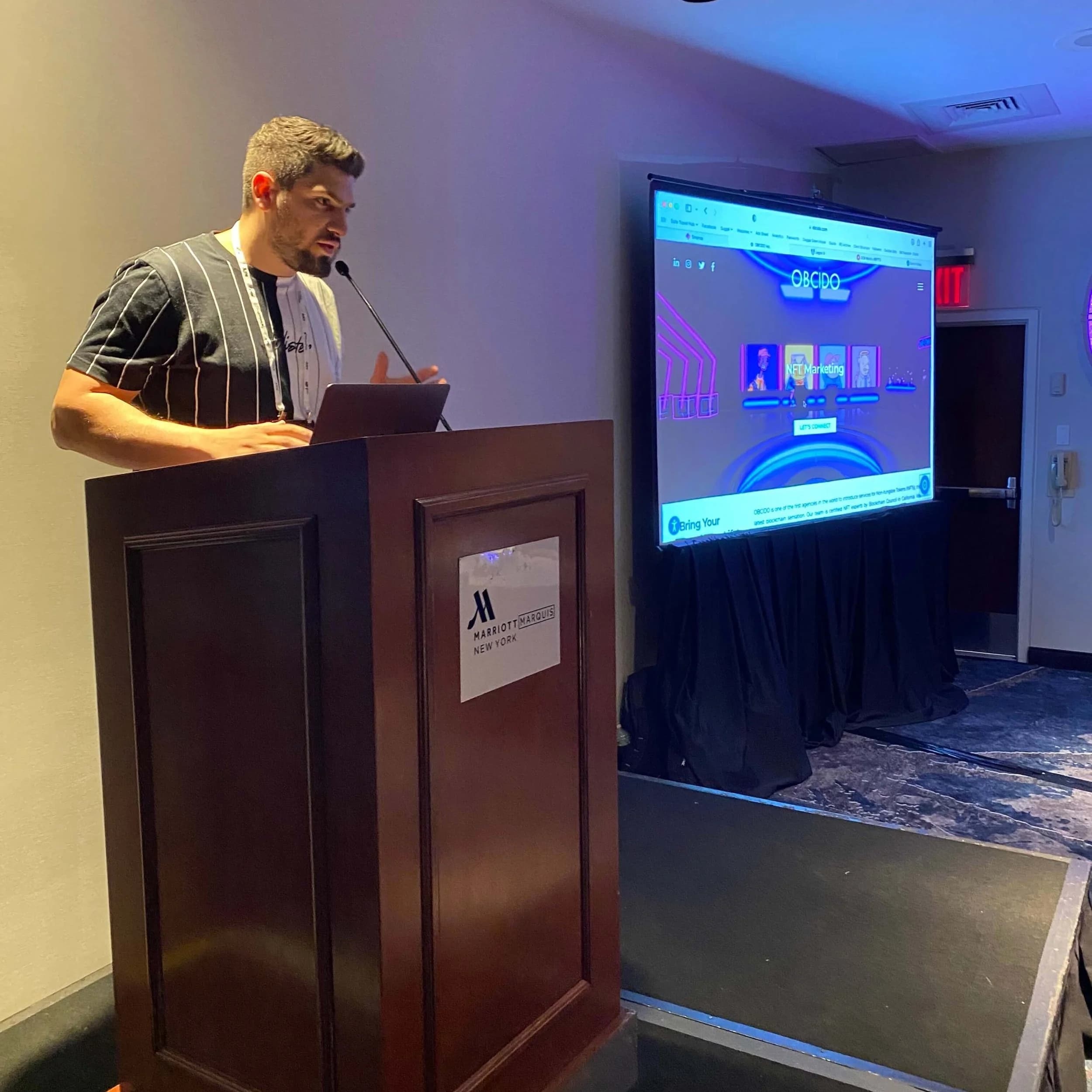
For years my identity was the agency. I co-founded a New York creative agency in early 2021, ran its operations, then led it as CEO from 2022: scaling the team, scaling the marketing operation, meeting clients across the US, Europe and the Gulf. It was the kind of chapter you dream about from Beirut, and I am proud of every year of it.
Then, in 2024, I founded Talentdu, an education company, in Lebanon, of all economies. It has since become my main work, and I have stepped away from the agency world to focus on it. People ask, reasonably, why anyone would trade global agency work for education in a country in permanent crisis. The reasoning is the most commercial thing about me.
What the agency years actually taught me
Agencies sell execution, and execution has two hard properties. It does not compound: every month starts from zero, every client win must be re-won. And it is being commoditised from below faster every year, first by cheaper competition, now by AI that produces in seconds what juniors produced in days.
But the deeper lesson came from watching clients. The difference between the companies that grew and the ones that churned was almost never the quality of the work we shipped them. It was the capability of the people inside the company to use it, judge it and sustain it. We kept delivering strong campaigns into weak systems, and weak systems win. The constraint on marketing results, nearly everywhere, is not production. It is capability.
Once I saw that clearly, the conclusion was uncomfortable for an agency owner: the most valuable thing I could sell was not the work. It was the ability to do the work, transferred into other people. That is called education.
Why education, why MENA, why now
Three things converged.
The capability gap is widest here. The region's young people are ambitious and digital-native, but the bridge between university theory and employable practice barely exists. Every employer I knew had the same complaint, and every graduate the same frustration. A gap this consistent is not a tragedy. It is a market.
AI raised the stakes. The Skill-Replaceability Matrix from my TEDx talk is not an abstraction: production skills are automating first, judgment is not. That makes practical, judgment-building education more valuable exactly as traditional credentials become less so.
Education compounds where services do not. A program improves every cohort. A university partnership deepens every year. An alumni network grows on its own. After years of restarting revenue every month, building something that accrues felt less like a pivot and more like finally choosing the right physics.
Betting on my own country
Building from Beirut was the part outsiders question most, and the part I question least. Lebanon's constraint produces a specific kind of marketer: resourceful, bilingual, performance-honest, priced for a regional market that increasingly hires them. Pairing that talent with university partnerships and global certifications, and pointing it at the whole MENA region, is not charity for my country. It is an arbitrage I understand better than anyone who has never worked here.
The slow race is the theme of my book, and this is the largest slow race I have entered: education is measured in years, reputations, and people whose careers change. I did not leave the agency world because it failed me. I left because I found the thing it was pointing at the whole time.