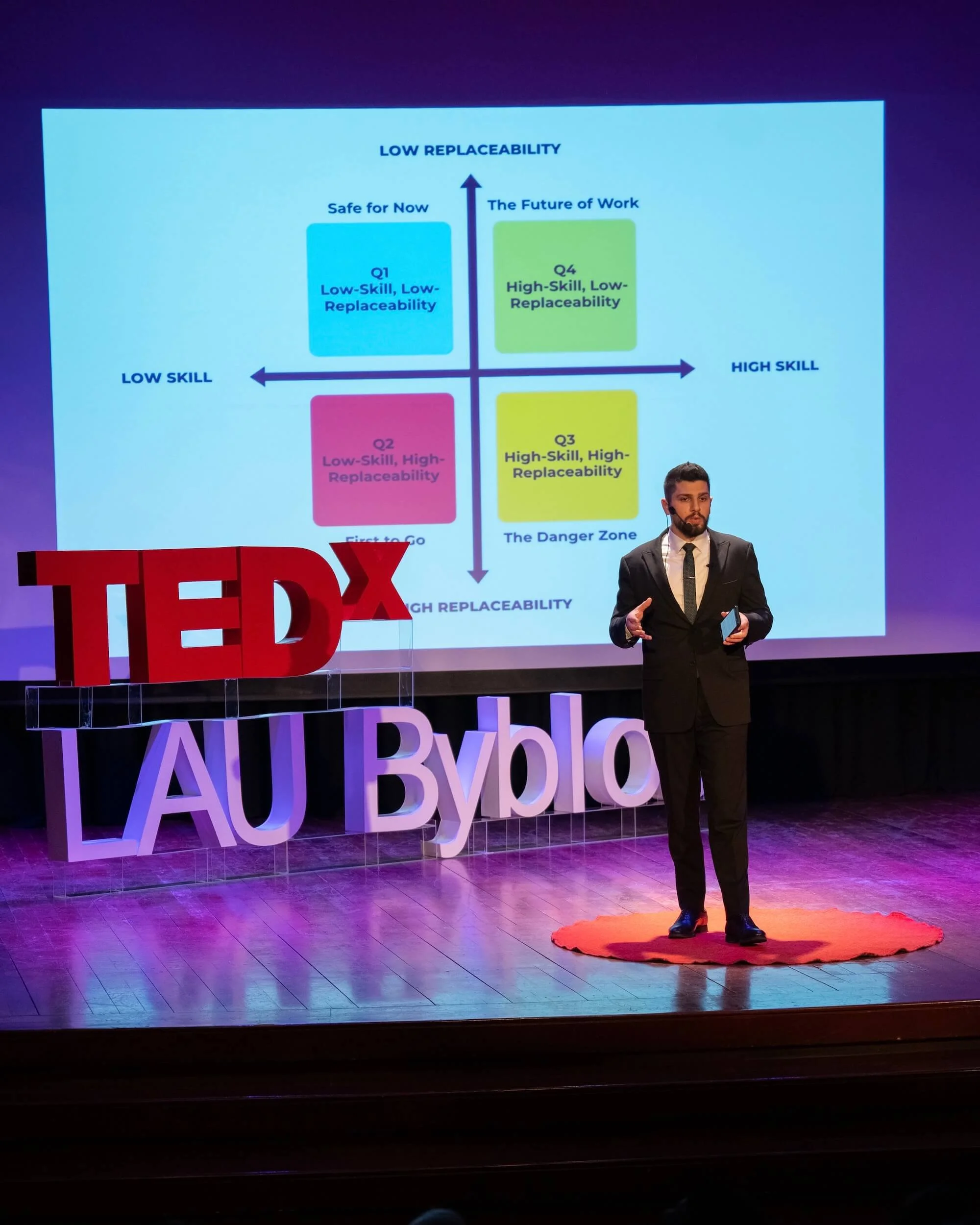
In April 2025 I stood on the TEDxLAU Byblos stage and asked a question most people in the room had already googled at two in the morning: will your job survive the AI revolution?
The honest answer is that it is the wrong question. Jobs do not get replaced in one piece. Tasks do. Which means the useful question is smaller and much more personal: which parts of what I do every day can a machine now do, and which parts still need me?
That is what the Skill-Replaceability Matrix is for.
The two axes
Plot any role, or any single skill inside a role, on two axes.
Skill level. How long does it take a capable person to get genuinely good at this? Writing a subject line is low skill. Setting the pricing strategy for a product entering a new market is high skill.
Replaceability. How well can current AI do this, unsupervised, at a quality a paying client would accept? Be brutal here. Not "can it produce something", but "can it produce the thing I would put my name on".
Two axes give you four quadrants, and each quadrant has its own instruction.
The four quadrants
Safe for now: low skill, low replaceability. Work that is easy for humans and still awkward for machines, usually because it happens in the physical world or depends on being present. This quadrant shrinks every year. Do not build a career here; the safety is real but it is rented.
First to go: low skill, high replaceability. Formatting reports. Basic image resizing. First-draft captions. Data entry in every form. If your week is mostly this quadrant, the matrix is not a fun exercise, and the move is urgent: climb, using the tools themselves to free the time to learn.
The danger zone: high skill, high replaceability. This is the quadrant nobody wants to talk about, because it holds work people spent years mastering. Mid-level copywriting. Standard media plans. Reporting and analysis that follows a known method. The skill was real, the years were real, and the machine does it in seconds anyway. The move here is not to compete with the machine on output. It is to move up one level: from producing the work to directing it, judging it, and owning the outcome.
The future of work: high skill, low replaceability. Strategy under uncertainty. Judgment with incomplete information. Trust, relationships, accountability. Deciding what should be done, not how to produce it. Every deliberate career move you make should be toward this quadrant.
How to use it on yourself
Take your calendar from last week and list what you actually did, task by task, not job title by job title. Place every task on the matrix. Most people discover their role is spread across three quadrants, and that the tasks they enjoy most are not always the ones in the safe quadrant.
Then do the exercise once more, but for eighteen months from now, assuming the tools keep improving at the pace you have already watched. That second version of the matrix is the one to plan against.
What this means for marketers specifically
Marketing is unusually exposed because so much of it is production: words, images, plans, reports. Production is exactly what the current generation of AI does well. But marketing is also unusually protected in one specific place, because the discipline's core question is judgment: what should we say, to whom, and why would they care? No tool answers that. A tool gives you ten options. Someone still has to be right.
I run Talentdu precisely because of this gap. The marketers who will do well in the next decade are not the ones who resist the tools or the ones who only prompt them. They are the ones who can direct the machine with taste and judge the output against a strategy they wrote themselves.
If you want the full talk, it is on YouTube. If you want help applying the matrix to a whole marketing team rather than one career, that is work I do.