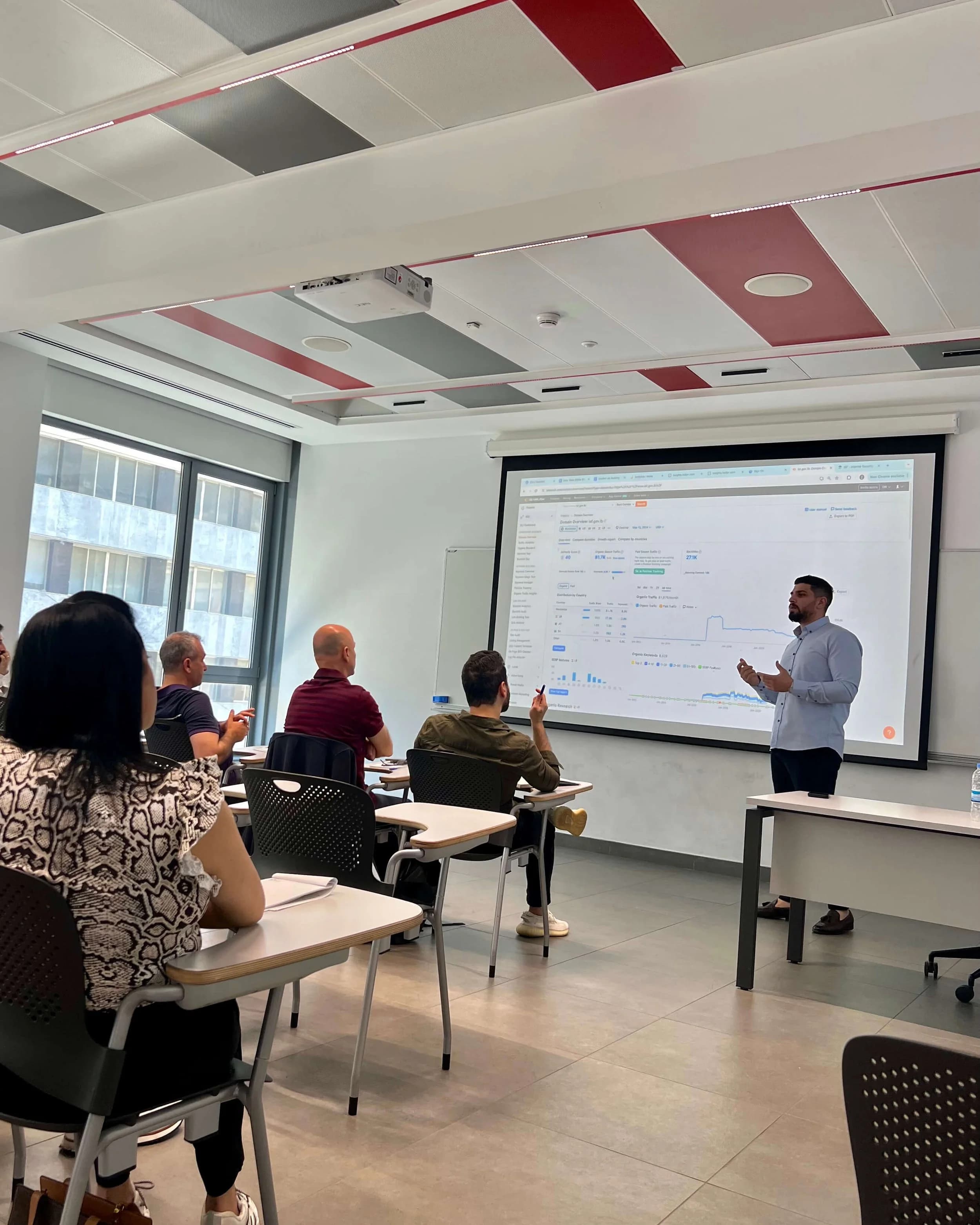
A company books a trainer. The team spends two days in a room. Everyone rates the workshop four and a half stars. Ninety days later, nothing about how the team works has changed. I have watched this cycle from every seat: as the founder buying training, as the educator delivering it, and as the advisor called in later to find out why the numbers did not move.
The failure is so consistent that it cannot be about trainer quality. It is structural.
Why it fails
It trains individuals, then returns them to an unchanged system. People leave inspired and re-enter workflows, approvals and KPIs built for the old way of working. The system wins within a fortnight, every time.
It teaches the general case. Generic examples produce generic recall. The team learned "how companies do it" and still does not know how we do it, here, with our product and our constraints.
Nothing is due afterwards. Training that ends at the applause has no owner, no deliverable and no date. Learning without a deadline is entertainment with slides.
What works instead
The training that changes behaviour, the kind we run through Talentdu for organizations, has three properties.
It runs on the company's live work. The exercises are this quarter's actual campaigns, this team's actual funnel, the real dashboard with the real embarrassing numbers. The room's energy changes completely when the material is consequential.
It ships something before it ends. A rebuilt campaign, a new reporting template, an AI workflow wired into a real task. The session's output enters the company's toolset the same week, which means the system changes along with the people.
It has a named owner and a ninety-day check. Someone inside the company owns each change, and a follow-up on the calendar makes the change auditable. This single practice separates training that sticks from training that evaporates.
The AI version of the problem
AI training is currently where this failure is loudest. Companies buy "AI for marketing" workshops, teams enjoy the demos, licences get purchased, and three months later two people use the tools. The fix is identical: pick the team's ugliest recurring workflow, rebuild it with the tools in the room, measure the before and after, and let the result recruit the rest of the team.
The question to ask any provider
One question filters most of the market: "what will exist inside our company on the Monday after the training that did not exist before?" If the answer is a certificate and a PDF of slides, you are buying morale, which is fine, as long as nobody expects the numbers to move.
If the answer is a changed workflow with an owner, you are buying capability. That is the only training worth a marketing budget, and it is the only kind I put my name on.